It’s pretty sad that Solid Edge does a better job of porting over Solidworks files than the new DSS product. mike miller , is that process as smooth as Siemens would have us believe?
Yes and no. There is a built-in Migration Wizard that reads SWX file types, saves geometry to .X_T and custom properties to .XML, imports the geometry and custom properties to new SE files, and connects all file links between parts/assemblies/drawings. In a perfect world it would be effortless.
However, there are a few things that either don’t work or must be redone in SE:
-complex corners, forming features, and complex geometry in sheet metal often have to be cut out and remodeled to allow significant editing down the road. You do NOT need to recreate the whole file though.
-not sure how well in-context relations come through, since we don’t use them.
-surface geometry is not editable.
-converting to sheet metal and recognizing holes and patterns are easy, but take time that isn’t shown in the demos.
-sheet metal with order-specific features (model, unbend, cut on bend line, rebend) may need some more love.
-not all mates migrate consistently.
-weldments are dumb solids. There is no way to create a cutlist from them, although you can edit them with the steering wheel.
All that said, with an accumulation of years of bad workflows and messy assemblies, it would take far longer for us to migrate to an SSP workflow in SWX than to SE.
That blows my mind. 
The 3dx solutions for “PDM/PLM” which is basically what you are referring to I believe is limited exclusively to the cloud version of Enovia.
I have not been an Enovia user, but my feeling is that, while it is very professional and seems to work well, it is also extremely rigid and “one-size-fits-all”. My brother has hands on experience with Enovia and he agrees with that statement.
Even Dassault agrees. (here’s one of the slides from a 3dx world presentation)
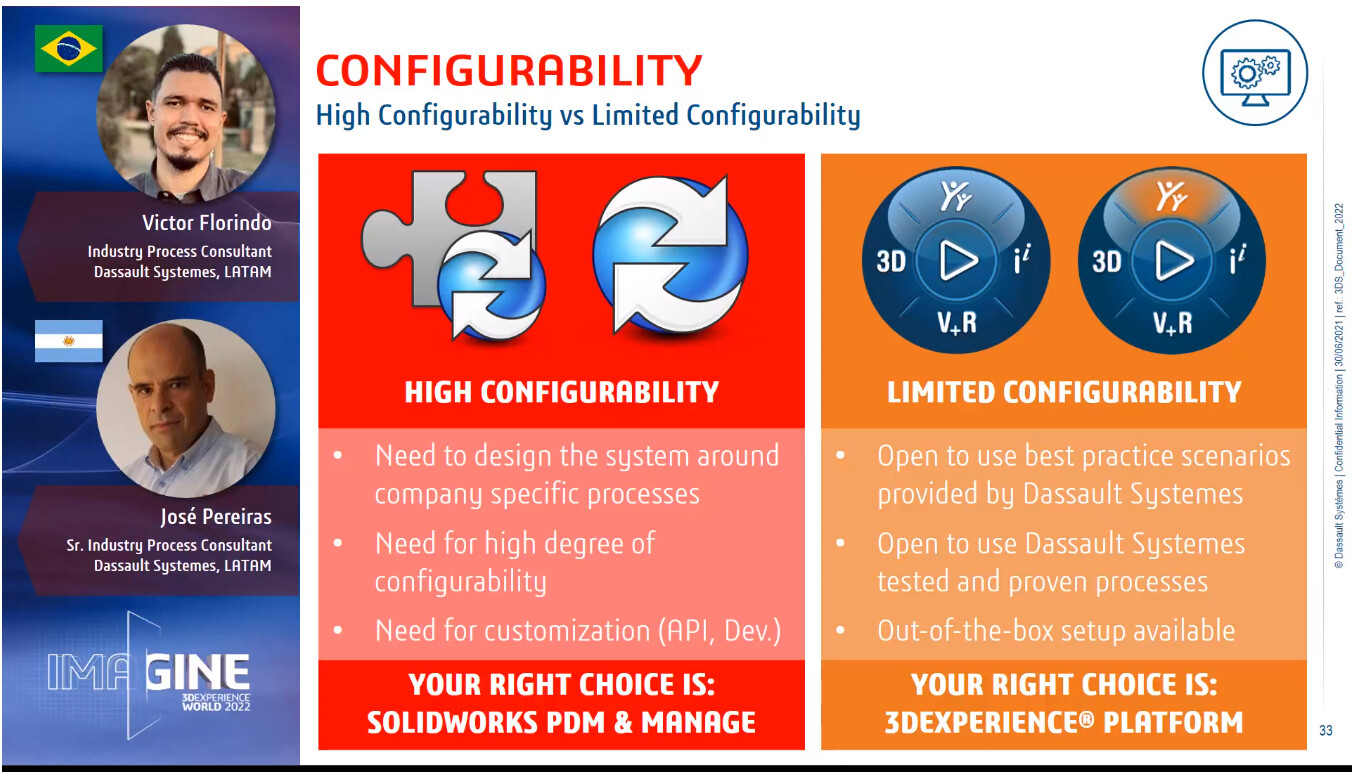
My feeling based entirely on thin air is that Enovia was built specifically by an aerospace company for an aerospace company. The eco-ecn and change management appears to be built very top down with a focus on approvals and a high level of auditability at all stages. When we were pitched Enovia at our last pdm/plm crossroad the salespeople were not able to show us a valid implementation of Enovia that worked with our business that would not introduce a huge bottle neck that didn’t already exist. (that said maybe they weren’t the greatest sales people) If your business model more closely resembles the model that enovia was built for, I think you could do very well, but if not, it could be a nightmare.
“Dumb” solid was a term invented by history based users. Direct Edit people never met a solid they considered unchangeable.
Here’s another Enovia related clip from an article previously linked referring to why Daimler-Mercedes did not go down the 3dx road.
image.png
If there is information lost and that information had value then the “dumb solid” name is very much applicable. Just because you can make changes, does not mean those changes are intelligent. Newer hybrid cad systems (with or without the use of 2d sketches) appear to be able to convey design intent effectively, which is promising.
I don’t think anyone is yet claiming that they can get the design intent out of a parametric solidworks model and turn it into a “smart solid”.
I disagree. It’s pretty clear to me. Quit listening to the promises and pay attention to what they are doing…Huh, thinking about it, are we all in an abusive relationship with Dassault?..
Why are you being so difficult! The solution is obvious. Everyone just needs to transfer their business over to the aerospace industry.
https://dezignstuff.com/edit-3d-parts-like-a-sketch/
https://duckduckgo.com/?t=ffab&q=solid+edge+synchronous+edits&iax=videos&ia=videos
Solid Edge finds features like rounds and patterns. And the direct edit enables edits that you simply can’t perform in history-based software. No, you can’t get back an equation, but you can get back all sorts of geometric relationships.
Synchronous allows you to tell the software what the design intent is and what the feature is at the time of edit, you don’t have to lock it in months in advance.
- killed off PDMW
- killed off home use license
- killed off network license
- killed off draftsight
- killed off SWWorld
- killed off SW forum
I don’t know, you tell me what direction it’s going. They’re going to make it so uncomfortable for you that you have to switch somewhere. The 3DExperience landing pad doesn’t look viable.
I get it that products change, but I’ve used products that have changed that have not killed off major chunks of functionality. Customers won’t reward you for disrupting their engineering process. Evolve, yes. Tear it down and recreate? No. Catia 4=> 5 ? No. That’s not progression, that’s burning it down and striking out fresh (which does have value, but not when you’re trying to bring a bunch of legacy customers with you).
I’ve seen that very article, I’m not arguing that the design intent can’t be added in solid edge, but you can’t really be saying that nothing is lost in a translation from solidworks to solid-edge? I think your previous reply answered this.
I’d say explicit intent is lost, but “implied intent” is what Solid Edge Sync is good at, or in other words, what a logical person would assume would be the intent. The Sync Live Rules look at things when you start a move or rotate and applies logical assumptions about how each face in the edit set should relate to other faces outside of the edit set. For instance if you select a hole cylinder to move and it’s axis is in X or Y alignment with another hole axis that is parallel to it, then it finds those holes and moves them so that they stay in alignment as if there was horizontal or vertical relationships between them. This applies to coplanar faces as well, and symmetry around the file origin, and a whole host of other things. There are also semi-automatic tools for detecting when cylinders should be intelligent holes (you would lose annotative threads) and when an array of features should be a rectangular or polar pattern. There are also selection filters to intelligently pick a series of connected features that make up a “feature”.
That’s basically what I have thought the case was. I think that explicit intent is important in some cases. I think we (meaning the company I work for in the packaging machinery industry) have a lot of “explicit intent” built in to especially our key parts.
I think in a translation from solidworks to solid edge we would lose a lot of real engineering value especially when you are talking about key mechanism components. critical dimensions, construction geometry in sketch, complex cams, linkages, custom sized parts based off of product drawings in sketches via construction geometry… etc.
SolidEdge and similar technology looks very nice and would probably work just a well as solidworks for most of our ancillary components (frames and structural components), and I’m sure its better than a dumb solid inserted into a solidworks “clone” like Inventor was the last time I used Inventor.
If I’m understanding what you’re saying then you are on the same path we were. But please do not be confused, Solid Edge did not abandon ordered mode (although there is maybe three OEM tutorials that don’t use it so you’ll need all your own training material, I digress) We turned off Synch Tech in several places, of course they like to turn it on by default with new installations so we kept a vanilla user settings file for new installations and on update to new version we would have to go back through and turn all that back off. It’s amazing the ruckus ST has caused, look how it took over a thread about SW CEO! I don’t understand why so many think it has to be one way or the other for all. Some do well on ST, some not, some do great on hybrid usage.
My point, if Solid Edge ST does not fit your usage, just don’t use it, plain and simple. SE in ordered mode is still about the same as SW, just a lot different. I used SE most of the time for several years, back in the v14 - v18 days then again at ST6, 9 and 2019. Couldn’t get ST to be a reliable workflow for our usage, maybe it was our SE VAR that did the training, maybe it was how SE was pushing it out, maybe we’re too dumb to understand how to use it. I don’t know.
After using SW off and on for the past ~3 years I don’t see a net gain from switching. The SE UI is better and I get the feeling that the Parasolid kernel Siemens is selling SW is a somewhat neutered version of what SE is rolling on.
This is all great, but we have like 500k solidworks components and assemblies and a couple thousand machines that are actively supported by those assemblies. Legacy support is very important to us and the loss of explicit design intent in a migration seems like it would be very expensive.
Ha yeah, I am aware of the hijacking going on. Sorry, but at least its tangentially related.
As someone who knows a little about the software, I can say you’re vastly overestimating your “design intent”. Half the time the design intent itself is what needs to change. The other half it’s faster to use direct edit to make the changes anyway.
Did you know that on an Imported assembly Solid Edge can change multiple parts at the same time? It would take hours to set up edits like that in-context with parent - child relations that most people break anyway.
Sit down with someone who’s not trying to disprove direct edit and you’ll see. It took me a couple of years to see the light. History based modeling is WAY overrated.
I hear ya on changing systems with existing data set. We need existing files for about 95% of requests that design is working on so pretty much needed the entire data set into the new system that we didn’t know much about. Looking back over the past couple years the cost of migrating data set to the different CAD system cost more than all the SW & PDM licenses initial purchase and maintenance combined. It’s hard to know which way to turn, especially when these software corps won’t be clear on where they’re headed.
As someone who knows less about the software I have some concerns about that statement. I feel that you’re missing some significant usages of the software.
Matt, it seems you refuse to consider that Solid Edge’s ST may not be the best solution for some.
SE offers both, and is a better company to deal with. There are some things history modeling does better, but I think in general a lot of history users lack imagination if they can’t see the benefits of combining methods. Two heads is better than one, right?