SW (BREP) vs CSG CAD

I just received a presentation of a CSG cad, no history modelling, and the maker claim to be absolutely faster than solidworks at everything.

On paper, with simple geometries like cylinders and boxes, minus the overhead from parameters, it seems legit (even SW is faster if you use an imported parasolid model when drafting), but I wonder how it will translate in saved drafting time and gains in modelling.

Their approach at CAD seems so dated, old school UI, no API without a developer license (and likely VS will be needed), proprietary format almost nobody can open. it uses an approach similar to the legacy Unigraphics files with 2d data embedded into the same 3d file.

Sales eng told me that importing steps or other brep cad data does not allow to repair faces, or other advance editing and we should just remake the parts??

they are also not pushing for a PDM (they have a product and a couple of third parties doing “something” but it does not seem to be mainstream even for their customers), and they just told us to copy and paste folders around and manage revisions with filenames… which imho is a suicide with a machinery with 17k components, many units shared with other machines and at least 2 to 7 revisions for many components.

Other than that we have 2M files into our vault: 13k files for catalog parts alone, likely somewhere between 100 to 200k approved latest revisions. All data conversion automation, libraries, macros, and a ton of metadata to throw into the trash bin apparently.

2 Likes

What CAD is it? Fujitsu/DiPro iCAD?

yes, fujitsu icad sx.

I forgot to paste the link.

Our parent division in Japan picked iCAD about 15 years or so ago over SW for designing automation equipment. I think it does cost a little less, and its performance with large models is very impressive. There are some advantages to history-free modeling without relations, mates, etc, particularly when you work in a multi-user environment. You don’t have to understand how the model was built in order to effectively modify it.

But as you have found, the interface is terrible… and more terrible if you have to use the English version. iCAD is software in the typical Japanese software mold - There is no effort made to make the software or interface intuitive or easy to use. The expectation per Japanese culture is to suck it up and do good work DESPITE terrible tools rather than take any action to improve the tools. Their support is also laughable. Basically non-existent in the US. We have a couple licenses for interoperability/expats/etc, and I needed to move our license server to another machine a few months ago. THEY REQUIRE YOU TO BE ON ACTIVE MAINTENANCE TO MOVE THE LICENSE SERVER TO ANOTHER MACHINE!!! Not to resurrect a license off a dead machine, just transfer a currently running server to a different machine. The process for them to verify that we were on maintenance and finally send us an activation code (yes, sending activation codes is a totally manual process over email) took A MONTH! The latest release/SP of iCAD is something like 2.5 years old, if memory serves.

When Japan made the switch, I was afraid it was going to be mandated for us as well. I would have quit. iCAD knowledge is basically zero value in the US job market.

1 Like

@josh thank you for sharing your insight.

Well, I am a bit biased about japanese made software, but basically I am 100% with your experience.

It seems that the user is just expected to put 300% effort to deliver 90%, while with a good designed software (or process) the user could just put 60% in effort to deliver the same.

I am not surprised employees just go burnout and quit after a few years or just months. Many companies have a very bad turnover here, bleeding people without any replacement in sight since the demographics are collapsing (while putting the blame on immigrants like me for basically everything, all the time :expressionless_face:)

Back on the software, I would like to understand it better.

icad seems so bad at drafting, that fujitsu and toyota group (which is a big user) are pushing for a drawing less approach: 3d only on the floor shop. which is ok for NC machining, but for assembly, welding and basically human heavy processes, that sounds like a very very bad idea.

I was told to "trust the plan”, they might have some humanoid robot that will follow the 3D only in mind, but I am not too positive on the matter.

UI is like something from 2001 at best, and the demo guys stance was like “you are so free to do this and that”, while replying to my questions with what amount to basically "do it manually”…

I am not convinced that faster view generation and chaotic data copy and paste around is the way, but I could miss something in the big scheme of things. IMHO everything has a merit and a demerit and they must be weighted very carefully.

I was able to link SW with open sourced software, selfdeploy it to hundreds pc, automate workflows and fix bugs by myself. Japanese vendors are more on the "pay us for consulting and we make a very stiff tool you need to pay us again and again to keep it barely functional”

Another thing that triggered me is that their japanese presentation was painting “euroamerican” vs “japanese” cad as a matter of a different mentality in mechanical engineering.

they basically said that in euro american companies engineers and process specialists have a strong top down process, while the japanese way is to cross talk back and forth between project leaders, designers, shop floor, workers… closer to chaos imho, but whatever they claim this is the main reason parameters are useless, and the engineer must direct edit the data all the time, without an apparent modelling strategy, without mates etc.

My take is that “it depends” on what you are modelling and at what stage of the process you are.

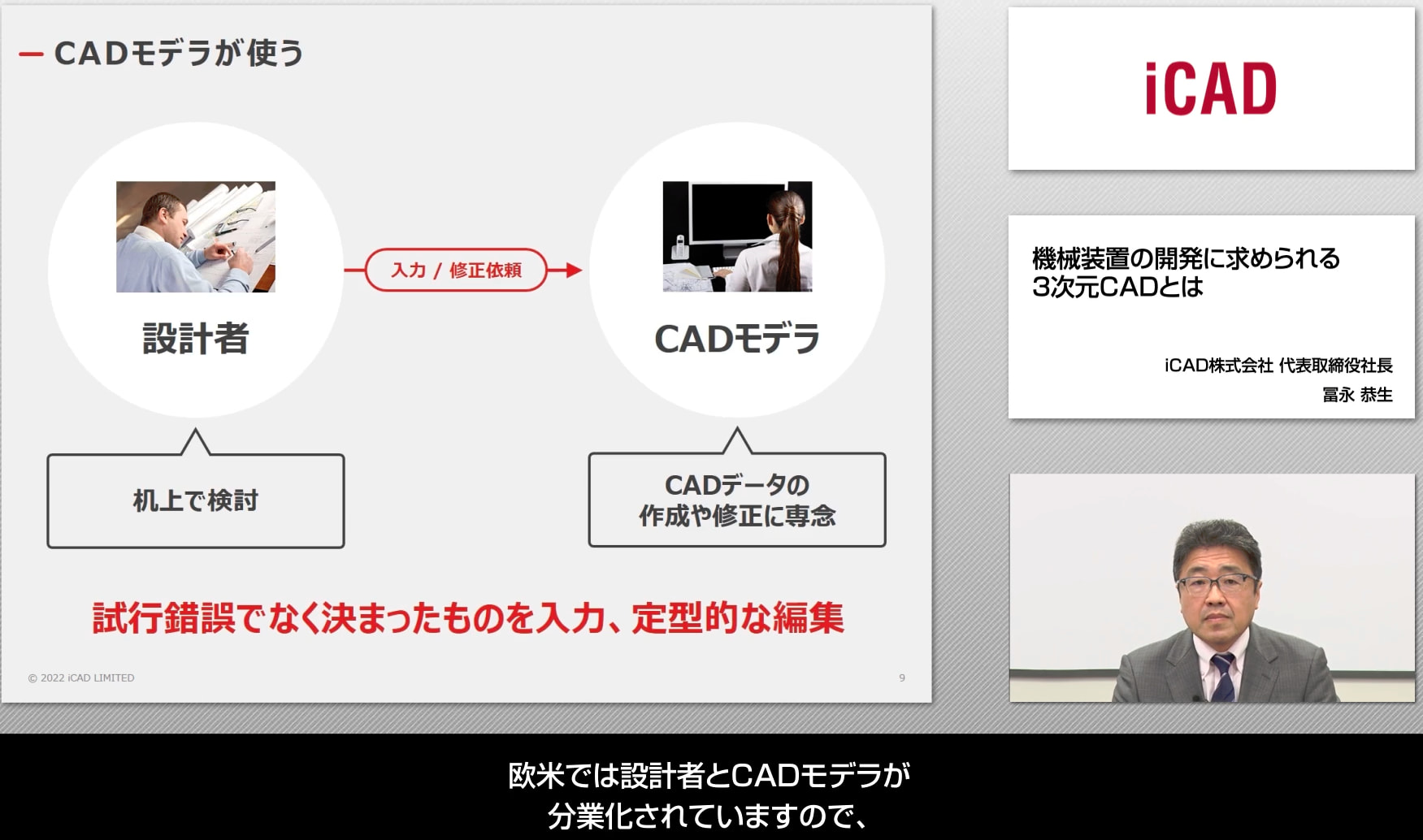
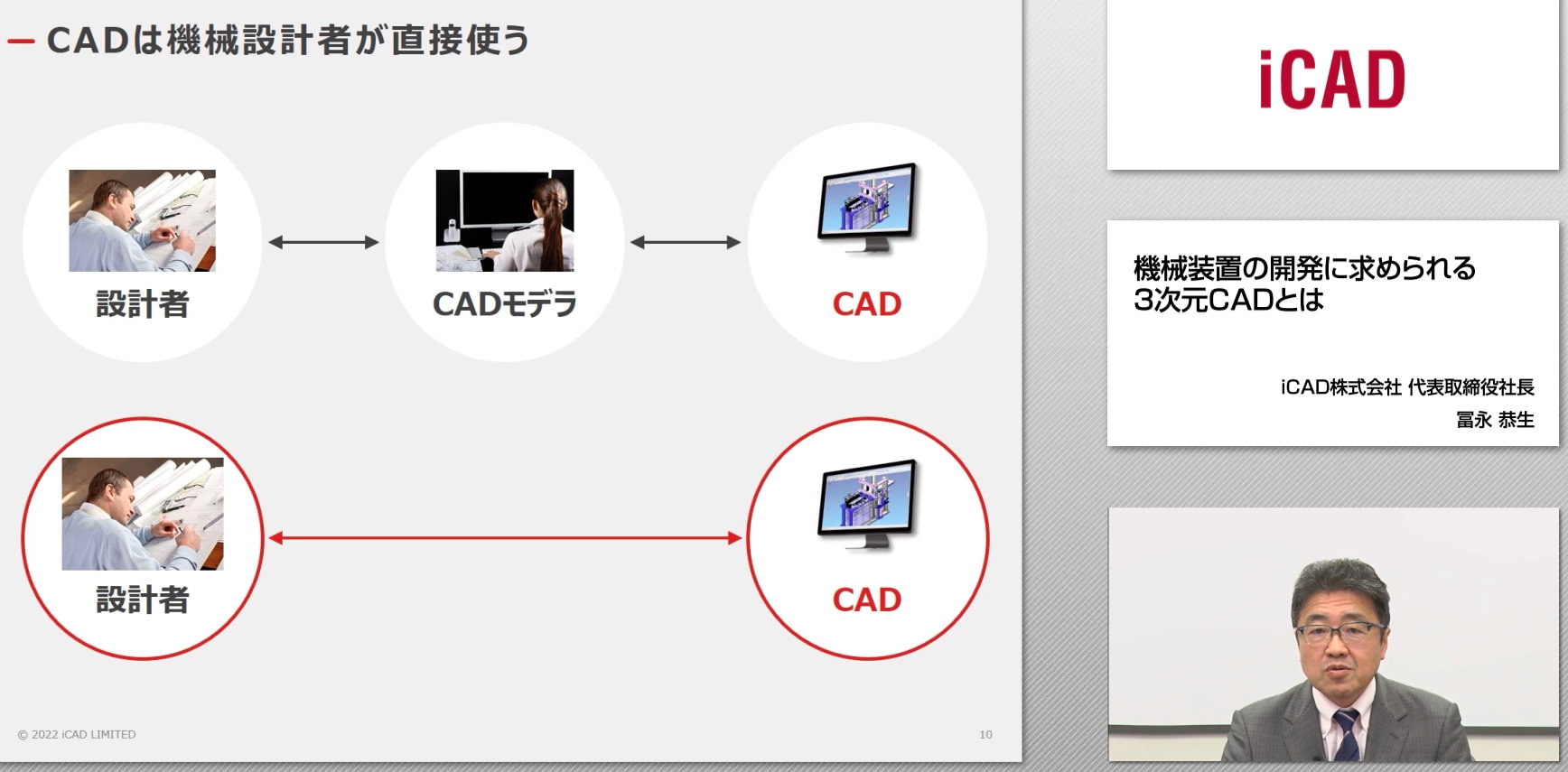
They also claimed that euro american design process involves a “modeler” between the engineer and the final product, while in japan the engineer must handle everything, including the 3d design.

it is also claimed in a presentation video (japanese the first video from the top, starting from around 02:15 iirc)

It sounded like a lot of BS nationalistic pride marketing.

CC: 欧米では設計者とCADモデラが分業化されていますので、設計者がいろんな設計検討をした結果CADモデラがCADを使ってデータ入力した。つまり、CADに求められる要件は決まったものを早く入力し定型的な編集を可能にすることになります。ところが日本では設計者が直接CADを使うというのが当たり前です。

In Europe and the United States, designers and CAD modelers are divided into division of labor, so as a result of the designer’s various design studies, CAD modelers input data using CAD. In other words, the requirements for CAD are to enter the fixed one quickly and make it possible to edit it in a regular format. However, in Japan, it is natural that designers use CAD directly.

In my European experience, 15 yrs ago while some place had drafters, all my employers wanted and pretended that every engineer was independent and able to use CAD, CAE and other tools. Senior management would probably give some input with minimum effort at CAD, but a mere operator that input data is not something a European company have in mind. On the contrary I saw the modeler approach in my Japanese experience.

When I started in the 90s using v4 Catia, it was all parameterless, not relations, no mates. They were adding some sketch and feature stuff but it was mixed. Assemblies was importing part models into an assemby part model with no link back. Sure it loaded quick but updates were time consuming.

We went to SolidWorks and one old user kept saying, “I didn’t have to deal with mate errors before”. Sure, but you had design errors and parts in the wrong place with no real way to know except for visually inspecting everything to the nth degree. Or wait until manufacturing tells you they can’t assembly it due to mismatched parts, which happened a bit.

1 Like

I was making 3d solid in AutoCAD 14. Helps a lot in checking if parts fit and holes line up. Don’t need to open 20 drawings try to figure where edge and holes are, and if they line up.

When I went to Inventor release demo, I was sold.

2 Likes

back in the days, Unigraphics v17 and a lot of non associative non parametric modelling… irc at GM to model doors and other heavy stuff, there was an approach called chunky method (or something like that) : extrusions and boolean. and a lot of “remove parameters" command along the road.

Non parametric, direct modelling is good along the way for “mature” 3D data modifications. Or stuff like mold design, to a CERTAIN extent IMHO. During development making modifications is just a pain without them and I am not sure if the gains we get are worth the risks and the losses of time along the road.

2 Likes

Yeap, hack and slash in AutoCAD soild.

You make a hole and want to make it smaller? Fill it up and make a new hole.

Part too short? Another sketch, another extrude.

It was fun.

2 Likes

I should add that I made some test and benchmark in SW as well.

Removing parameters and re importing dummy parasolid bodies speeds up the drafting of an order of magnitude.

I did some acad 3d too.

like icad it is a CSG engine, not bREP like SW.

I commented above that direct modelling has its place in mature designs, but keeping together a coherent assy and associative drawings, could erode the gains (zero regeneration time) we get from the faster 3d alone.

it is a mixed bag imho and the hybrid approach like nx and solidedge with both parametric driven and direct modelling could be the best comprimise, but it must be coped with the company way of designing and maintaining engineering data…

What I see is management, being sold a solution for a single specific issue, model regeneration time, which is only a bit of the whole workflow. There is no magic bullet out there, everything have a trade off.

my 2 yen

I would look at Siemens Solidege which Solidworks licenses the d3d Kernal from. It is faster option for history free modling

iCAD modeling is the similar to CATIA v5 automotive modeling every part is mated to a common plane in an assembly. It is fast but is a pain to move parts, and can lead to fubars if there is any miscommunication between engineers. And when you move parts you need to recut it if it is built of existing surfaces in the assembly, which takes time. Catia you can get away with this as it surface modeling is second to none and it is easy to cut paste features from one source to another,

1 Like

thank you for the reply.

could you expand a bit your assembly comment? I have looked at icad manuals and it gave me a similar impression. I was like ok, direct editing seems faster, but when I am designing new stuff and move things around am I supposed to micro manage everything and looking for every component and subassembly that may fall apart??

direct editing is supposedly faster for single parts already at a mature stage, but for complex machinery with shared components is going to be an hell imho…

and they are marketing us icad without a pdm, so it is the old 2d way to work, data copied around and managed in folder without version control…

basically every part is offset from the cartesian 0,0,0 point, usually in automotive your BIW surface is dropped into the top level assembly and the 0,0,0 point is the center line front of the body and the base is the offset ride height of the car in real life.

What engineers do it get tasked with copying bits of the BIW model surface and turning it to manufacturable part, basically chopping the surface for the roof then thickening it the add the b-surface structure and mounting holes for clips etc. the interior guys take the b surface and model part to fit that BIW B surface based of the clay model mock up 3d surface. Sometimes if your lucky the 3D interior surface and BIW will fit. The engineers end up fleshing out the middle.

The tricky bit is reusing parts, for example going from a SWB to LWB, the part number is the same but the model is different because they off set SWB part to the LWB position by doing a copy move, thing like clips and screws can’t really be inserted like we would in SW, what they tend to do is create a subassembly with the fasteners in and turn it into a dumb solid.

the manufacture then takes that solid and put it in the main assembly as a dumb solid and if fixed via the 0,0,0 plane.

This works fine as they buy the assembly from subcontractors and only car what revsion the sub assembly is being fitted on the production line.

also catia can link the dumb solid to the subassembly it is made from, as Catia PLM its really good for this

Once the biggest hurdles with doing this is you have to create seperate assembly’s that a mated as they would be in reallife to simulate movement for validation checks.

I think creo and NX users build car assemblies in a parametric way. But not Catia V5 users due catia V4 legacy issues.

Also doing method is why boeing cocked up the kc-130 tanker contract. They used the database to build the plane from existing parts and didn’t bother to check the volume of fuel it could hold.

They priced the contract based off reusing existing signed off parts, once the found the design would hold enough fuel, the had to redesign the plane with a lot of new parts to me the contract requirements. which cause massive overspend on the contract.

thank you.

I am familiar with automotive design, since I used to make injection molds for some tier1.

Every model had its position in space placed from the top WCS, so we had to reorient them with UG moldwizard in the cavity linked geometry to have the correct pull direction without altering the original 3D orientation.

What I was asking was a confirmation if iCAD uses a similar concept of geometry just dropped together in the space.

The demo guys just stretched multiple components in a subassy together like a 2d cad operation, modifying all the files. which is practical and horrible at the same time since it depends on the way your company work.

For us it would kill half of the machinery models, but the management is not going to understand some fine technical explanation.

My understanding is that is a kind of workflow that assume a single use files.

One folder one job approach as stretching multiple files like that, without any regard to their origin and on very a specific modelling context, is not going to make the life easier to our engineers.

Also the lack of parameters forces a continous dimensioning of faces and edges on the model, instead of picking up parameters from sketches and features with a double click in SW.

I can see a place for that kind of modelling and I agree about solidedge, but we are in a group that is using iCAD…

From experience Management need to answer these questions…

Why change from current package SW to iCAD?

And if the company was using iCAD why is your part of the business using SW?

I suspect iCAD cannot do some of the stuff your doing in SW.

Also if you are to move to iCAD what is the cost to recreate all the models and drawings from SW to iCAD?

It sound fundamentally disruptive to change the business workflow that currently works.

iCAD is a remenant of a long dead 3d modeling ethos from the 80’S.

I suspect system your might be talking about is top down modeling with all the sketches in the assembly inventor for example promote this but it is terrible for reuse and control management. due to how interlinked sketches can get.

inventor top down assembly modeling ( awful way to design machines)

1 Like

I agree with you, iCad has a old school approach. basically fujitsu stopped the development 20 years ago. As a CAD system it is based on few commands and functions and that’s it. It had its place for certain legacy ways of designing things and it fitted a certain japanese way of handling manufacturing. Which is unfortunately outdated, but some managers are apparently fascinated by it.

There is also a misunderstanding imho, since part of the group adopt icad, but it is not even orderly implemented, without a modern pdm system. The persons I spoke saw it as a merit, since it gives engineers more flexibility and they can send the files here and there freely. IMHO it is just chaos, not flexibility, and revision control, workflows, better integration with modern programming and third party ecosystem, including a vast library of free macros and programming resources are a must.

Tell them it will cost them 20miillion YEN to switch.

1 Like

It is probably going to sound too cheap at 20M… I think accounting the retraining, going back to a non pdm environment, a use case that is basically how wr did 2d cad 30 years ago, and the loss of productivity are going to be heavier than that amount, but it is difficult to calculate unless you deploy the whoke thing to all the departments and see the working hours after a couple of years…