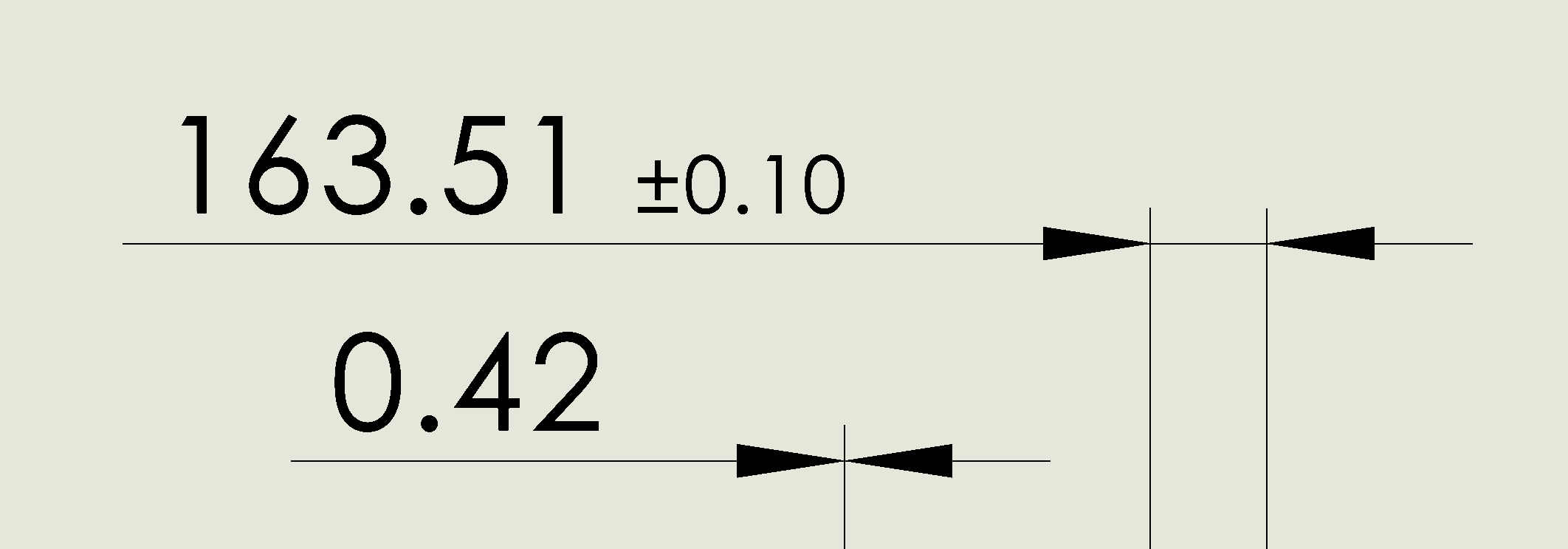
Your example leads me confused. 90 doesn’t need a leading zero. Only degrees less than 1 need a leading zero. Are you saying you want a dimension that is .7 +/- 0.5?
Yep, we’ve had that problem before too. You’re not going to get much of a response other than quotes from ANSI and/or ISO standards to this kind of question. I’ve read enough prints from the shop floor; paper or digital to understand where you’re coming from. At the end of the day it’s not worth arguing wrong or wright, the standard wins. The only other option I’ve seen that doesn’t get lash from the puritans is to make everything bigger and use more sheets. Depending on the shop and how drawings are laid out, they might like more sheets or might hate it.
Are there any rational arguments for dropping leading zeros other than the small amount of space it saves? And I don’t mean “that’s what the standard says.” I know that “it’s the standard and we follow the standard” is a more than valid reason to do it. I just mean objectively is there any situation or metric by which it’s a superior way to communicate a value on a drawing. It used to save some lettering time, but not anymore…
I think it comes down to giving another way to indicate wither a drawing is USC or Metric, inch dimensions do not have a leading zero but have trailing zeros were as metric dimensions have a leading zero but not trailing zeros, just my penny.
Right. I’ve been asking that question for a long time and have not received an answer that stood up to logic. I once heard there was great debate about who got to keep the leading zero. It had nothing to do with function. I’m not going to say that this part of the standard is dumb, but it is dogmatic.