My apologies if this topic already exists… If so please go ahead and point me to it.
Otherwise, what are some of the interesting modeling techniques or clever challenges you’ve come across?
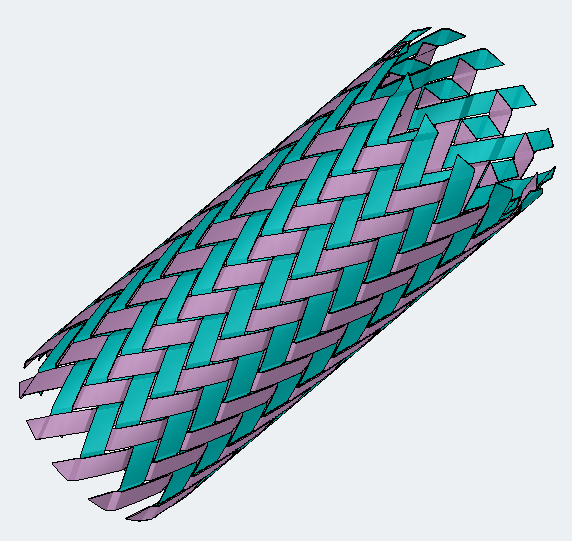
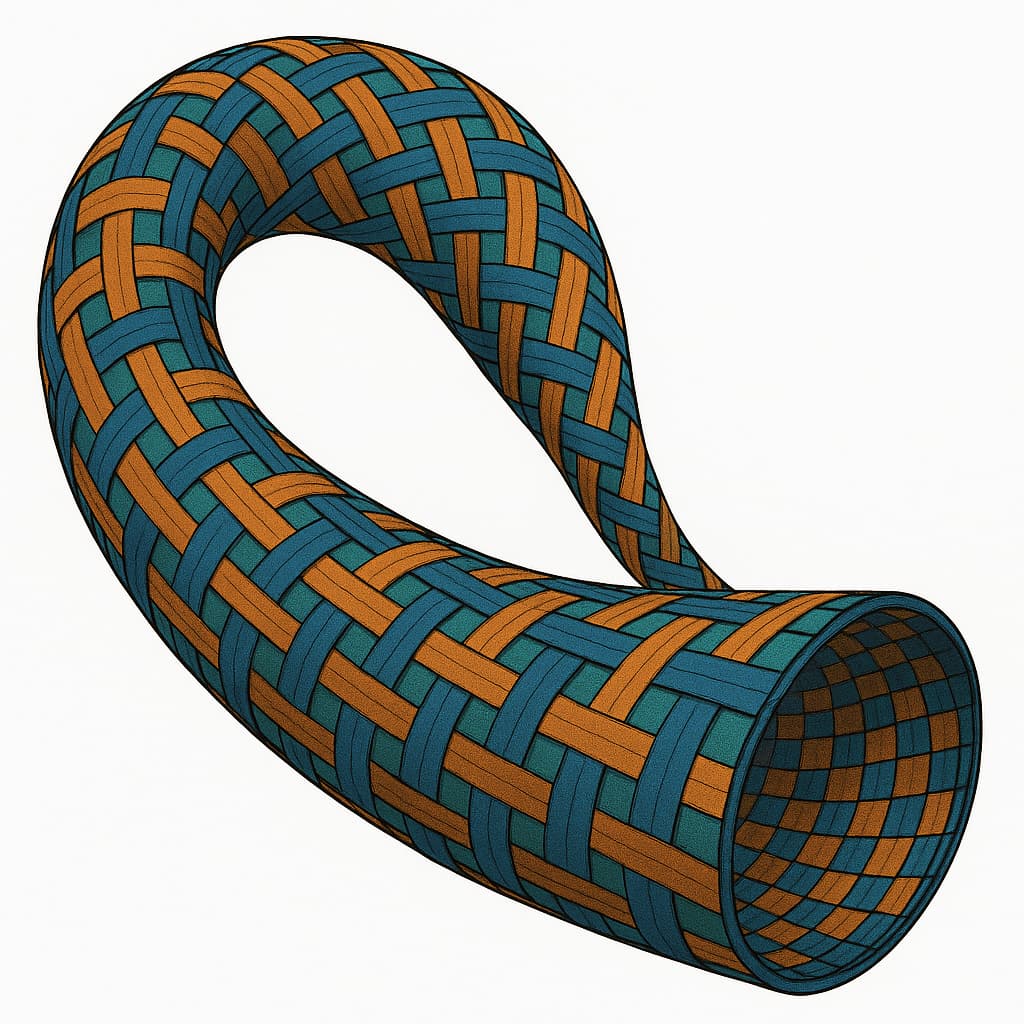
This one popped up on the SW forum the other day – Modeling a woven mesh tube. Of course I don’t think I’d recommend ever actually using one in a larger model due to performance issues, but it piqued my interest to see if it would be feasible. After sussing out the basic technique, I wondered if I could make one fully parametric. Presented for your entertainment, here’s the result. All of the parameters are global variables in the part file. You should be able to edit any of the global variables that are not calculated values to a “reasonable” extent and get a model. Particularly interesting are the number of overlaps and the rise over run or “slope” of the twist of the fibers. Fill ratio is the actual width of the fiber vs the angular spacing.
Beautiful model, really well thought out. I would only suggest cleaning up the tool bodies with Delete/Keep Body feature at the end of the model tree, but otherwise, great technique.
I’m on 2025, so I can only go back to 2023. Maybe someone else with 2024 can drop it back to 22?
If not, I’ve included a parasolid as well so you can at least look at it if you want, although of course you can’t adjust the parameters. Here’s a screenshot of what it looks like as well.
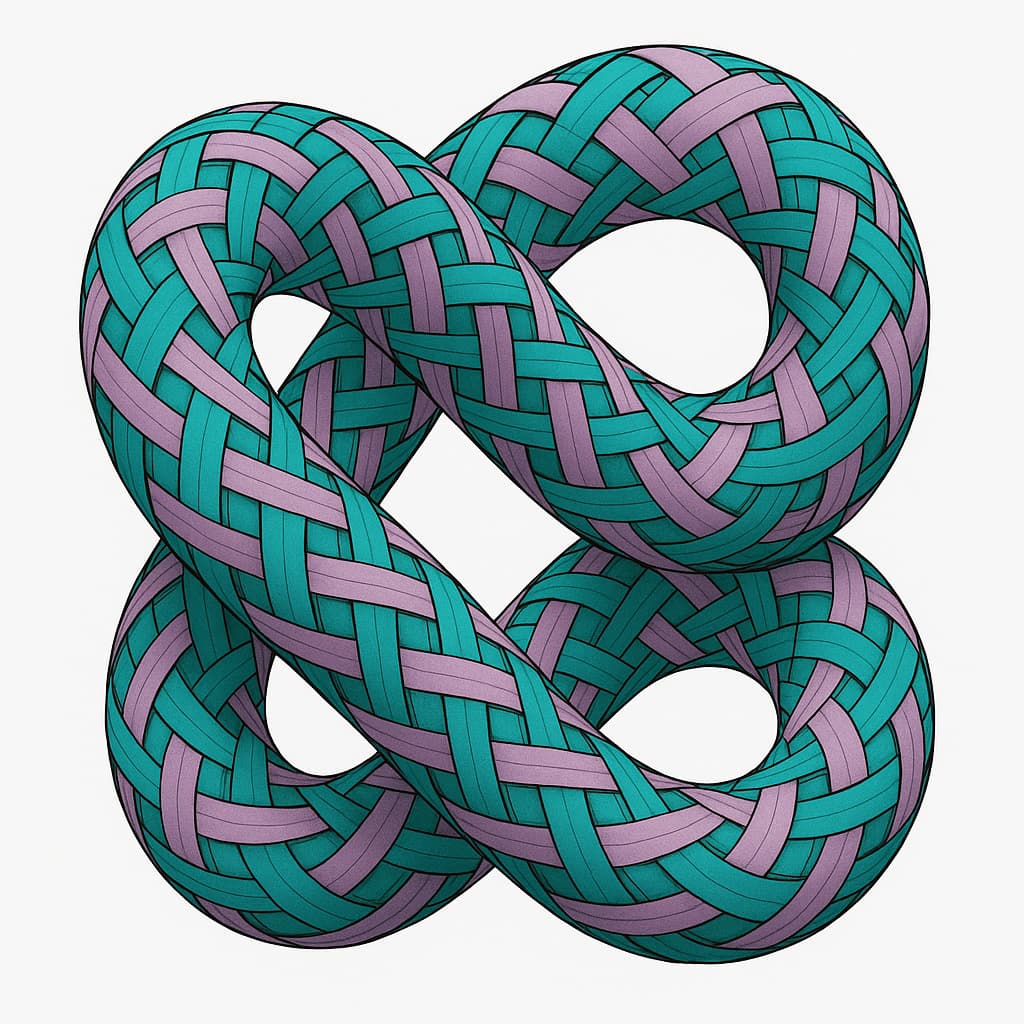
Oh, I see that your pipe is straight. Your weaving is very cool and I would like to see the parameterization. But, to be honest, I thought that your pipe would be on a curved trajectory - that would be super cool.
Yeah, curved would be another level. some of the basic methodology might be extendible to a swept shape, but I think the processing load would jump exponentially.
How did you create your image? Is it a texture/appearance or something?
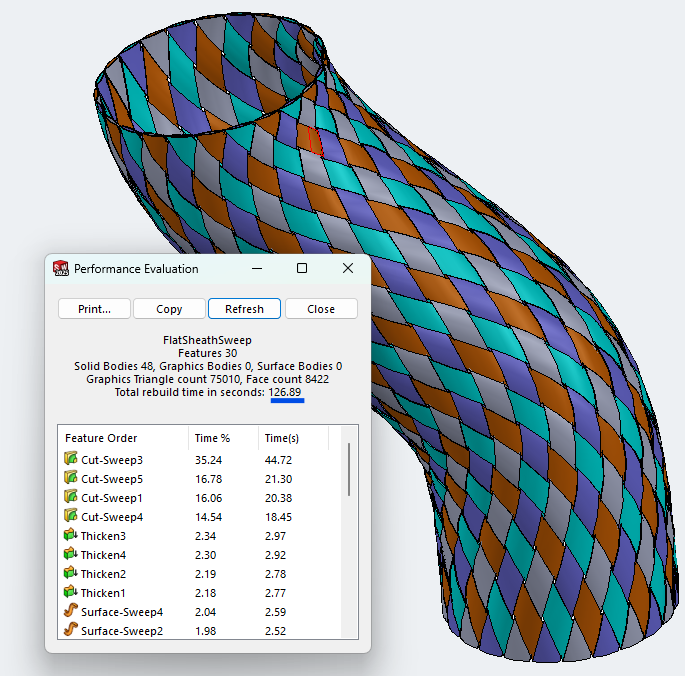
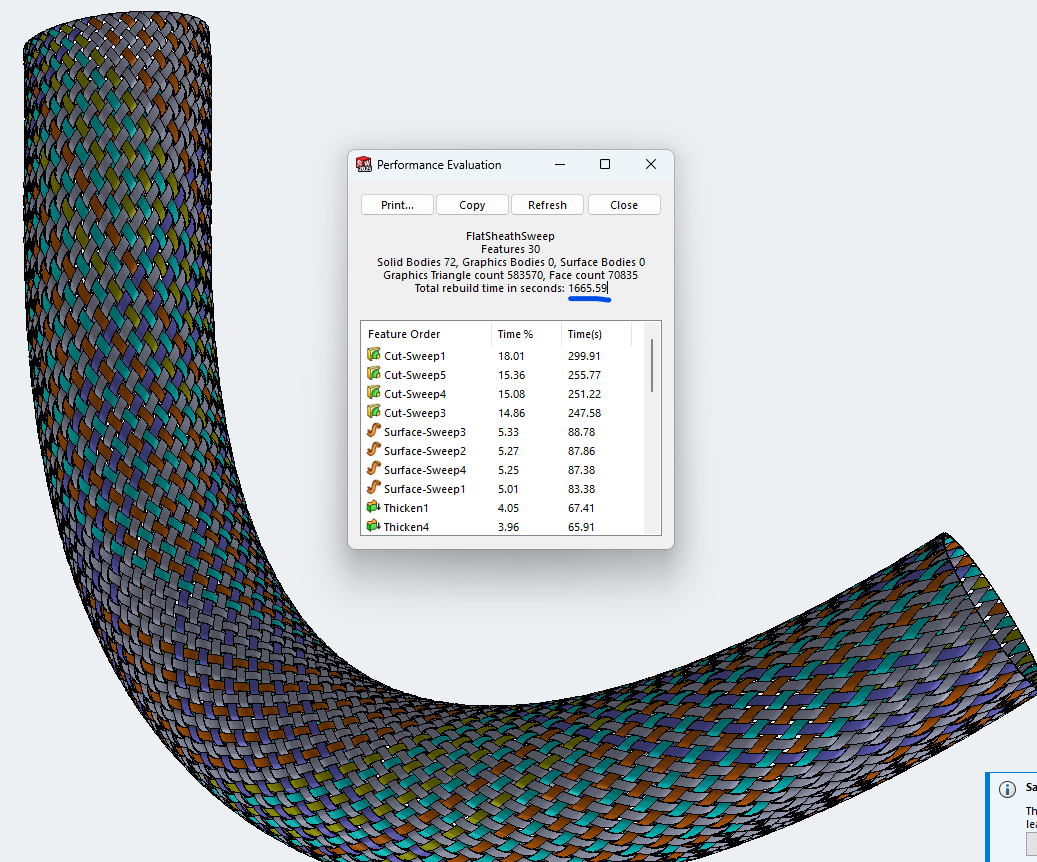
So… It is possible to do it in a curved trajectory. But as I expected, it’s exponentially more time to rebuild since every single strand is a completely unique body. It requires 8 unique sweep with twist operations. It’s also not able to be parametric for number of crossings. Two crossings would be possible with this method, but it would require 8 unique sweep with twist operations instead of 4.
Here’s the part file… It’s not nearly as polished. I’m not sure what variables can still be edited without breaking it. Just unsuppress the whole tree. I had to suppress it to get file size down from 40 meg. FlatSheathSweep_2023.SLDPRT (454.8 KB)
You might have reached the limit of my Solid-Fu on that one… I can conceptually imagine how it might be possible, but instead of four sweep with twist (which is fairly reasonable to set up), you would have to go down a deep, deep, deep rabbit hole of lofts with multiple profiles and guide curves, all with eye-crossingly intricate vertex management. Not for the faint of heart!