Drawing House Plans

So,

I’ve done this before, and it’s been tedious.

I have a picture of the plans of a house we are in the process of buying.

I’ve got a measurement scheduled today, as the house built doesn’t exactly match this.

I know how I’ve done this in the past, and it didn’t work well, so I’m not going to preface with that.

Would love to hear suggestions on efficient, and flexible ways model the house.

cheers,

What is your goal/purpose/end use of such a model of the house?

I don’t know what could be the problem… On one sketch you draw all the rectangles for the rooms and the outside line and the extrude the the ceiling height.
Then add the doors and windows openings.
Maybe 15 minutes in total?

I started drawing our house so I could play with it with FlowExpress. I am struggling with error in measurements. I started with the outside perimeter of the house and then made that a solid up to the main height a bit above ceiling height, then started adjusting for the rooms with lower ceilings. I then shelled that and started adding the walls between rooms with thin extrusions. Each room gets a sketch, but I have found that it doesn’t all add up, and I’m missing measurements. One of my other goals is to determine how much open space there is between some closets with the thought of perhaps enlarging one of the closets.

Good luck. If you start with good measurements it should be more straightforward.
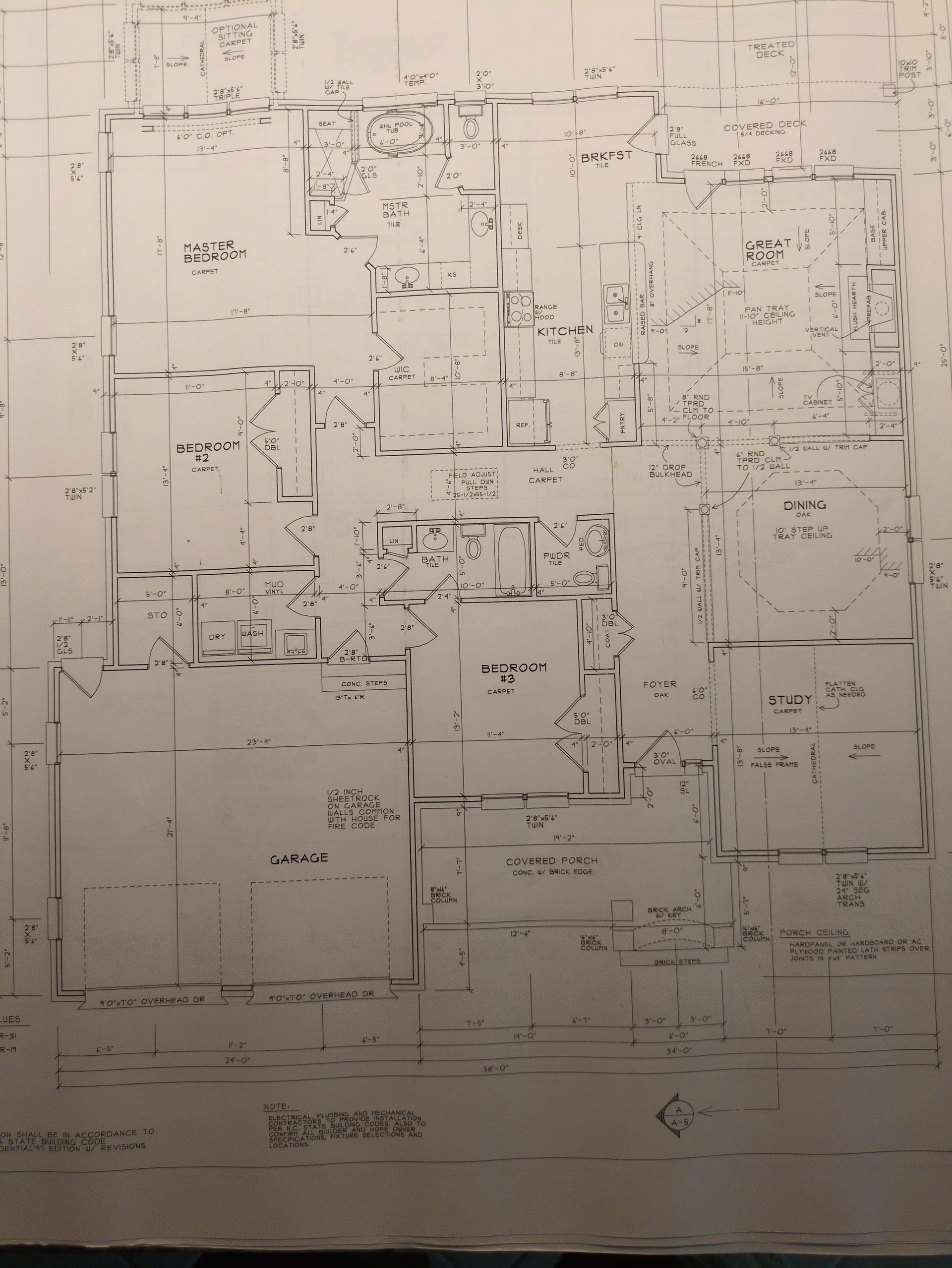
Architectural drawing. Tolerance +/- an arm and leg.

They never build to drawing dimension. Good luck finding a straight wall in the house.

Never trust any post/column location. Was doing plant layout for machinery. Those i-beam are off a few inches on x and y.

We’re going to do a bit of modification, and then spot furniture.

I’ve tried something completely different this time, in which I did a centerline sketch of all the walls with dimensions.

Then I added rooms, one by one, by drawing centerlines in a new sketch, then doing the offset (in both directions) for 4" walls. Then extruded the hollow shape the height of the ceiling.

The beauty of this way is the dimensions are easily editable in the centerline sketch.

Was relatively quick, but definitely NOT 15 minutes…

And yes, I will verify

Well… If you wanna be even more quick-and-dirty, just draw your centerlines as solid lines and then use “extrude-thin” with a thickness of 4.5" (don’t forget the drywall)…

Don’t think like a machinist. Nothing is straight. Nothing is flat. Nothing is parallel. Nothing is perpendicular. Top and bottom of wall will measure different.

Start a sketch on the top plane and go from there.
If there is an elevation change add a new plane.
if you want do a sketch for each room after you have the outside mapped.

You are preaching to the choir, my friend. I’ve personally built one house, re-habbed another entirely, and had a house built by a contractor.

Straight is merely a state of mind, no more, no less.

cheers,

Does anyone have any experience with any of the house design software packages? From what I’ve seen it automates much of the heavy lifting, but I’ve never tried any, so it could all be marketing hype.

Guessing walls will be 4-1/2" if 3.5 studs and 1/2 drywall on each side.

The 4.5" figure I mentioned is relatively close to 4-1/2"… :wink:

I just took a rough measurement of a wall here at my house, and it appears to be ~4-16/32.

We’re just ignoring baseboards now? You all are going to be very upset when you are sitting 9/16" closer to the TV than you planned for.

Depending on the flooring, might even have to account for either 7/16" shoe molding or 3/4" quarter round. :rofl:

I asked chatGPT and it says there is a 1" difference between 4.5 and 4 - 1/2.

Maybe it thinks there’s a difference between 4-1/2 and 4 - 1/2?

I think my walls are 9/2 thick.

does the meaning of the symbol change if there are spaces on either side of it?