Has anyone ever come across the term “deconstructed” BOM before? I was in a call yesterday where some colleagues were using this term as though it was perfectly normal but it’s not something I’ve come across before.
Context: the drawing I was reviewing had a BOM on it, the implication being that Part 123 is made from Parts 456 and 789 (i.e. you’d buy/make 456 and 789, then build in to 123. So you need drawings for 456 and 789 to know what they actually are).
The reality is that we buy Part 123 off the shelf, then split in two to make 456 and 789, which are then processed in a couple of different ways before coming back together later.
My colleagues were claiming that the drawing is valid because “it’s a deconstructed BOM” i.e. you take the part that you have in your hand and then disassemble to get the noted part numbers. There was no text on the drawing explaining this.
My colleagues are in Canada, is this an ASME / ANSI / North America concept I’ve been hitherto unaware of?
Do the parts come back together in the same way they were originally? If so, I wouldn’t create 456 or 789 as separate part numbers at all. I would call this a modified purchased part. So it would be a new assembly with part number ABC. The assembly has a single item in it (part 123). If part 123 is an assembly model, all the components would be virtual parts. All modifications are done at the assembly level and detailed on the drawing of ABC. Instructions on the drawing would explain the process. Something like this:
- Disassemble shaft from housing
- Machine shaft as shown on sheet 2
- Machine housing as shown on sheet 3
- Reassemble shaft and housing as shown on sheet 4
Display states are used to hide the non-relevant parts for the details on sheets 2 and 3. Configurations are used in the ABC assembly to show the original and unmodified model.
I’ve never encountered the phrase ‘deconstructed BOM’ working in the US and working with Canada.
No, they don’t go back together in the same state they come apart in. 456 gets some additional machining done to it, and 789 gets built in to a cable assembly. So an extremely simplified version of the BOM is;
1234567 - Clever Box Assembly
— 111 - Modified Box Housing
------ 456 - Box Housing
--------- 123 - Off The Shelf Box
— 888 - Box Lid with Passthrough Cable
------ 789 - Box Lid
--------- 123 - Off The Shelf Box
------ 777 - Bit of Wire
------ 999 - Connector
— 333 - PCB
This structure is accurately reflected in the BOM / CAD model. It’s just the drawings for 456 and 789 both point to the 123 drawing, which reading in the conventional way just turns in to a circular reference, i.e.
1234567 - Clever Box Assembly
— 111 - Modified Box Housing
------ 456 - Box Housing
--------- 123 - Off The Shelf Box
------------ 456 - Box Housing
------------ 789 - Box Lid
The workaround for which is to claim the 123 drawing is a “deconstructed BOM”. Which from reading around doesn’t seem to actually be a thing.
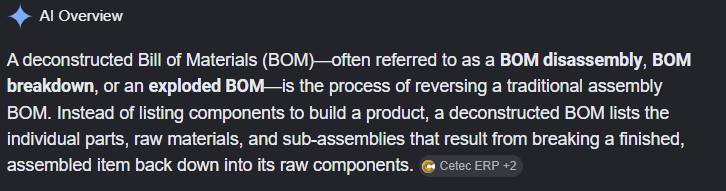
From the Google AI, for whatever that is worth.
Does that Cetec ERP source give anything more useful? The AI summary I get from Google basically describes a regular BOM 
But they do come back together. At some point, the lid goes back on the box. This isn’t a scenario where the two pieces of the purchased item end up going to two unrelated assemblies.
Why does 888 exist at all? Can’t the work done to assemble the lid, wire and connector be shown in the 1234567 drawing? Then 111 would show the mods to the housing and lid of 123, 456 and 789 become unnecessary and 777 and 999 move up into 1234567.
For the most part, it exists “because history”. 888 is considered an “electrical/cable assembly” so would be built by one guy who knows how to handle a soldering iron, while the top level box is just screwing things together so would be built by a mechy. Having them split as different part numbers makes it easier to communicate who needs to do what.
Yes, it should have different part number.
123 cannot be a purchased part and a modified finished product.
123 will split into 2 new number which combine to another new number.
Otherwise you’ll have no idea if the 123 on hand is new or finish.
This 123 in the box is both new and finished until you open the box.
How does the system track inventory? Is this 123 just came in or ready to ship?
And I’m Canadian. Not in a box, yet.
At the cost of a confusing BOM structure. In an automated system, your BOM would cause the purchase of item 123 twice. Big no-no.
The electrical/mechanical split is always a pain point. Where I work, we actually have separate electrical and mechanical BOMs. In the mechanical models/drawings all electrical components are envelope components and are thus excluded from the BOM. They typically have a flag note ‘SEE ELECTRICAL SCHEMATIC XXXXXX’ pointing to them. If similar looking components are present, a note with the part number might be added to avoid confusion when assembling. The electrical BOM has all the details on those parts and the electrical schematic may have an outline of the mechanical box and a similar cross-reference notes pointing to the mechanical drawing.
It mostly works for us. The biggest issue is deciding who owns what. Certain items like motors fall solidly in both the mechanical and electrical camps, so good communication is required to avoid double ordering.
Also, Google Gemini defines a ‘deconstructed BOM’ as what SOLIDWORKS calls a Parts Only BOM. Useful for the purchasing group who doesn’t care that the qty 100 1/4-20 X 1" long screws get split amongst 10 different subassemblies.
The BOM for 456 asks for QTY 0.5 of 123.
The BOM for 789 asks for QTY 0.5 of 123.
So when the parts are ordered for a 1234567, we (correctly) only QTY 1 of 123. So that much is in hand.
Hmmm, so, if I punch all the parts out of same sheet, form and weld them back together, it can use the same part number as that sheet.
Not with the system we use. Purchased parts don’t have drawings, so an assembly would be required to capture the ‘modification’. The modeling gymnastics required to make such a thing work would quickly reveal it to be a silly approach. Also, sheet goods like that fall under raw materials here and we don’t give part numbers to raw material.