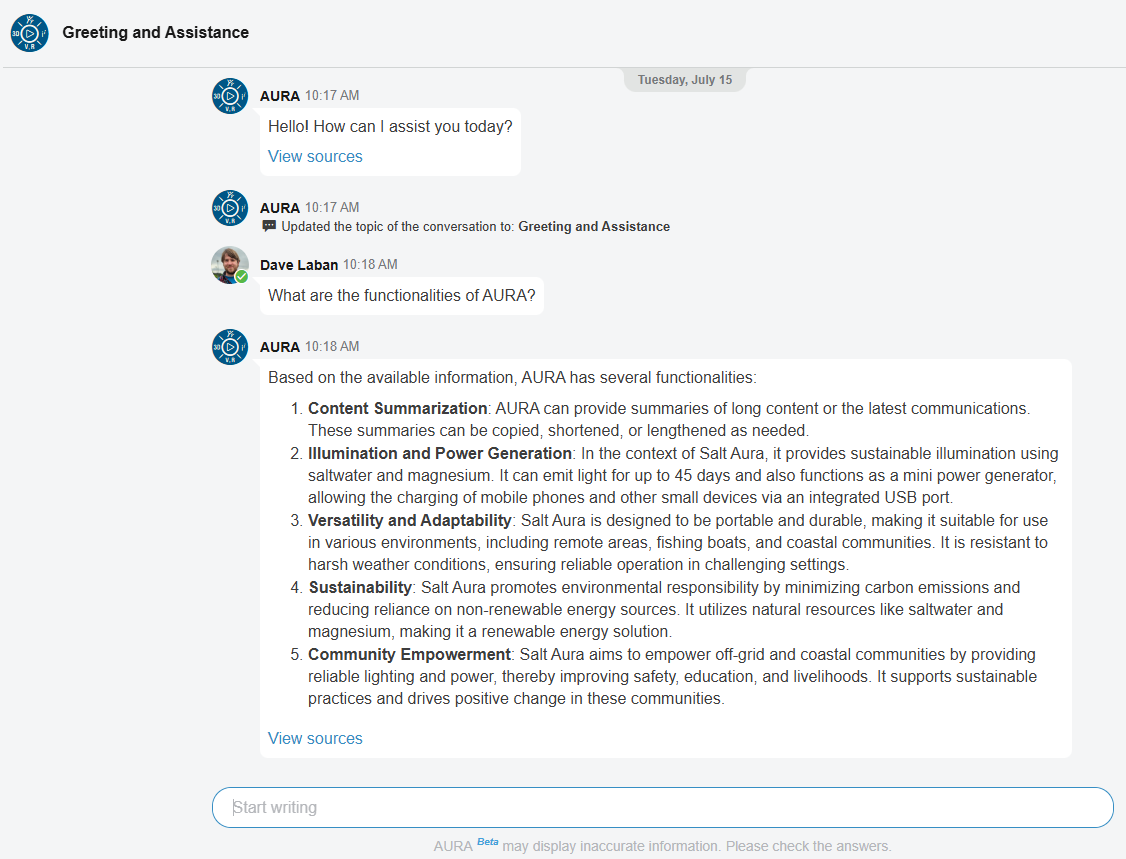
So DS have launched “AURA” in to Beta, which is their new “AI companion”.
Can’t say I’m terribly impressed with the answer to my first question.
Good, AI with no self awareness.
A bit salty …
Someone search Salt Aura on google and find an article that speaks of how the A.I. uses saltwater and magnesium to emit light for up to 45 days please, I can’t figure out where it’s pulling it’s information from and I find it quite perturbing that it seems to be “hallucinating” so much about explaining it’s own functionalities.
Can’t wait for the next meeting to hear how ‘fast’ their A.I. is evolving. Seems like that was the center point for the last one.
Could you click on Sources and see what link it provides for it’s sources? The response seems a bit off.
“Trained on Solidworks training guides, best practises and help docs.”
Among other things, apparently.
It’s a SolidCopy.
With so many stupid people deploying stupid AI, I don’t know what to believe.
I’ve now turned off public visibility of post edits, so this should no longer be the case.
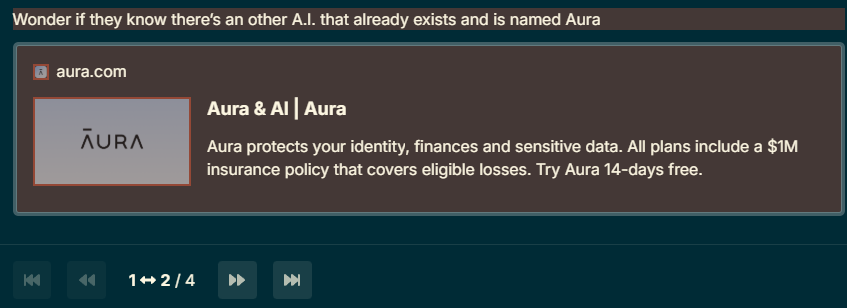
I thought they were the at first, I am not sure though which is why I deleted it.
I was wondering how that was happening 
I would say trained on unproven “best practices”.
To make Solidworks work is like snake oil and voodoo.
light weight? detached drawings? try opening from network? draw quality slider?
Large Language Models do not have conceptual knowledge about any topic. The response is entirely based on what is the most likely token to come after the previous string of tokens. This is based on tokenization of a vast set of text data (doubtful the SW documentation is a large enough data set to teach the English language) and tuning parameters on that set of tokens. The input prompt is tokenized and the model calculates the probability of the next token. There are a bunch of runtime tunable parameters; ex. temperature, top k, top p, min p, etc. that affect the creativeness or diverseness of the responses. In the generative image side they rely on high level of hallucinations to create new content. That makes sense as art doesn’t need to be grammatically or technically correct, unless you have a problem seeing six fingers on one “human” hand.
For a company with a reputation of breaking the limits of disruptive innovation I’m not surprised they have these tuned pretty hot.
That’s what I think I know about LLMs. Feel free to correct or call me out, I’m still learning.
Basically statistics based on what is known. SW API will be fun…
Yes, I could (and I really rather like that it cites its sources). It was this article in the Catia users community.
Yeah, I like the principle of providing sources too, you can then also judge the source to know how reliable the information is.
There was also a Powerpoint presentation in the list it pulled from somewhere that mentioned the word Aura in it, but seemingly had no link to the response it gave.
Unfortunately I don’t seem to have access to the Aura Beta any more so can’t interrogate further.
If Aura is referencing the SolidWorks Reddit, its most certainly doomed.
It will be badass at doing people’s homework.
The article says:
“Trained on Solidworks training guides, best practises and help docs”
I get the feeling that is as far as they went. God help anyone trying to use it for API work. That documentation is hot garbage.
It’ll be entertaining.
We might learn new way to model.
Maybe the AI will conclude Inventor is better … 
From what I recall, the training materials had no best practices. I used the offical training materials to train new users where I work. But I spent the first hour just talking how to visualize a part and where to start. Then through the exercises, question the users on where to start with samples of our in house parts.